 Twenty years ago, a blank WordPress editor blinked at me. I typed something about “the dawn of a new era” and then immediately bracketed it with a joke: “(or maybe I should spell it as ‘the dawn of a new error’ ?)”. I had no idea how prophetic that would turn out to be. Not the error part specifically (though there were plenty of those) but the self-aware humour about things going sideways. That’s been the thesis of this blog ever since.
Today, liviutudor.com turns 20. And if I’m being honest, I didn’t think it would. Not because I ever planned to stop (nobody ever does!) but because life, careers, relocations, side projects, family, and a global pandemic have a funny way of turning a “posting pause” into a three-year silence. (More on that in a bit.)
So let’s take the birthday as an excuse to look back. Where did this thing start, how has it wandered, and (this is the part that actually surprises me) where it’s ended up.
Era 1: The Dawn of a New Error (2006 – 2008)
The first post was dated May 6, 2006. The content? Essentially: hello world, I wonder how many hits I’ll get, probably zero. (Spoiler: I was not wrong about the zero part. Not immediately, anyway.)
Back then, the blog was unambiguously personal. Life in Europe. Half-Romanian, half-something-else identity crises. Observations about technology that read now like cave paintings from a pre-cloud civilization. The writing was loose, frequently funny, occasionally self-deprecating to the point of performance art.
There was no plan. No content calendar. No “SEO strategy.” Just a guy with opinions and too much caffeine and a text editor. Which, honestly, is still kind of the vibe.
Era 2: The Java Years (2009 – 2014)
Somewhere around 2009 the blog started developing opinions that required more than one paragraph to express. Java appeared. Spring MVC appeared. Maven problems appeared, as Maven problems always do, uninvited and inexplicable.
This era produced posts with titles like “Script to Quickly Create a Java Spring MVC Project” and “Evernote API – Small Maven Problem” — the kind of hyper-specific technical content that gets approximately four readers, three of whom are having the exact same problem you just solved. (Those three readers are your entire reason for existing as a technical blogger. They will never comment. They will copy your code and disappear into the night. You will feel great about it.)
Digital marketing and online advertising started weaving in too: “Implications of Blocking 3rd Party Cookies?”, anyone? Written in 2013. Still relevant in 2026. Some problems age like wine. Others, apparently, age like fine cheese that never actually goes bad because the industry is too invested in it.
Era 3: Engineering Leadership and the Maturing Voice (2015 – 2018)
By mid-decade, something shifted. The posts got longer, the observations got sharper, and the persona started looking less like “developer writing about things” and more like “senior engineer with things to say about how teams and organisations work.”
Posts about engineering and marketing, the psychology of technical jargon, dependency overload as cultural metaphor, leadership anti-patterns. The personal anecdotes didn’t disappear, they became the setup, the hook, the human scaffolding around a technical insight.
This is also, for what it’s worth, where the blog’s best writing lives. The “story ? insight ? application” framework wasn’t deliberate at the time. It was just what happened when you’d lived enough situations to tell a story before making a point. Turns out experience is mostly just pattern recognition with emotional resonance attached.
Era 4: The Long Quiet (2019 – 2025)
Let’s be honest about this one. The blog went quiet. Not dead, but quiet in the way a pub goes quiet at 2am: still technically open, but nothing much happening.
There were reasons. A career that got busier and more consuming. A side project (more on that shortly) that stalled. The global collective trauma of 2020 that made it genuinely hard to write anything that didn’t feel either trivial or overwhelming. And, if I’m being really honest, the slight paralysis that comes from wanting to say something worthwhile and having raised the bar on yourself somewhere along the way.
The irony is that the years I wrote the least were arguably the years I had the most to say. Go figure. Next time I’ll write it down instead of just thinking it very loudly.
Era 5: The AI Renaissance, and Why This Blog is Different Now (2025 – Present)
Here’s where it gets interesting. And a little bit meta.
In early 2025, I picked up a side project I’d shelved three years earlier (Calendrz, a privacy-first calendar availability tool) and decided to see what would happen if I rebuilt it with AI agents as my engineering partner. The short version: a three-year-shelved project came back to life in roughly a week. The slightly longer version involves 19-hour build sessions, a manual agent loop, 13 scheduler tools mirroring 30 MCP tools, and a recalibrated understanding of what “senior engineering” actually means when you have agentic tools in the picture.
That experience forced me to write. Not because I wanted to, but because I genuinely didn’t know what to think until I tried to explain it. Writing, it turns out, is still the best debugger I know for unclear thinking.
Since then, the content has found a real focus for the first time in the blog’s history. It sits at the intersection of three things:
- AI-assisted SDLC: what it actually means to build software when agents are in the loop
- Agentic orchestration: the architecture decisions that matter when you’re designing for AI consumers, not just with AI tools
- The human part: what doesn’t change, what judgment calls still need a human, and why the “buy vs. build” calculus is different when the build cost has collapsed
Posts like UIs Are Becoming Optional, Voice + MCP: The Interface That Finally Kills the Dashboard, and Agents, MCP, and What a 19-Hour Build Changed About How I Think are doing something the 2006 version of this blog wasn’t. They’re not just recording what I did. They’re working through what it means.
The Numbers Nobody Asked For (But Here Anyway)
Twenty years. Sixty-plus pages of posts. At least three major blogging platform arguments with myself (should I move to Ghost? Substack? Write on LinkedIn and stop pretending this is different?). One complete visual redesign. One three-year posting hiatus. One AI-induced creative renaissance.
The categories have shifted dramatically:
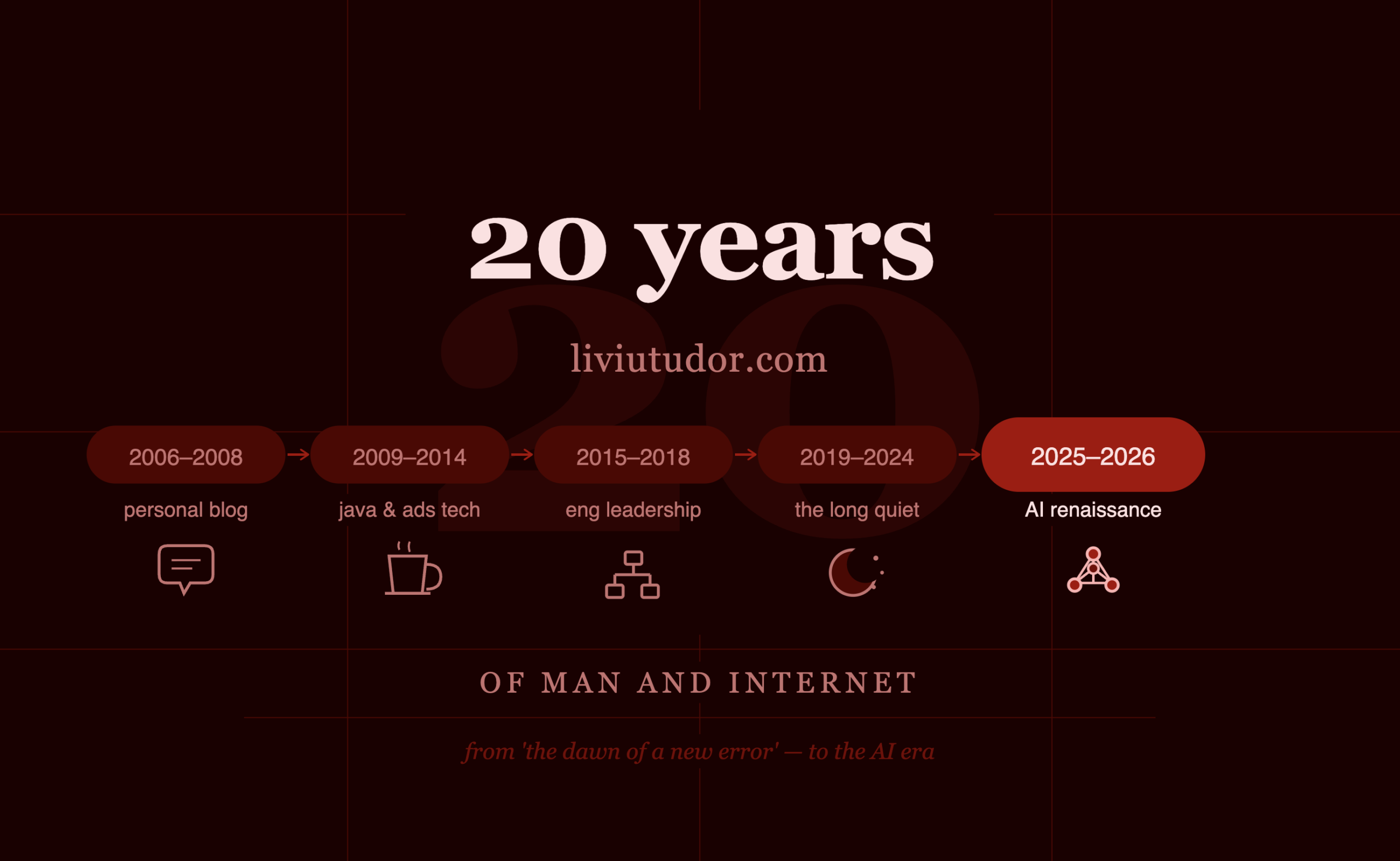
- 2006 – 2008: Personal rambling, life observations, early web commentary
- 2009 – 2014: Java/JVM technical depth, digital advertising, the odd travel photo
- 2015 – 2018: Engineering culture, leadership, tech + business intersections
- 2019 – 2024: Sporadic. The occasional thought that escaped into the world.
- 2025 – 2026: AI, agents, MCP, the engineering philosophy of building with AI
If you squint at that arc, it’s actually a career history. Which I suppose is the honest answer to “what is a personal technical blog?”: it’s professional autobiography written in real-time, one post at a time, occasionally with terrible jokes.
What Stays the Same After 20 Years
The tagline on this blog has always been “Of Man and Internet.” I’ve never changed it, partly out of laziness and partly because it still feels accurate. The internet changed. The man changed. The intersection of the two is still where the interesting questions live.
Some things haven’t moved in two decades. The writing still starts with a story. The point still needs to be earned, not asserted. The joke is still load-bearing. And the best posts are still the ones where I genuinely didn’t know what I thought before I started writing.
If anything, AI has reinforced this. When the tooling can generate competent boilerplate on demand, the thing that justifies writing is exactly what boilerplate can’t replicate: a point of view forged in actual experience, with the scar tissue to prove it. The perspective is the product. Everything else is just formatting.
A Word of Gratitude (Bear With Me, I’ll Keep It Brief)
To whoever has been reading this thing: thank you! Genuinely. The posts that got four readers and one of them solved their Maven problem: that’s the whole point. The posts that sparked a conversation, a LinkedIn thread, a “hey I was thinking the same thing”: even better.
To the blog itself: happy birthday! You’ve been a weirdly reliable mirror for 20 years. I don’t always like what you show me, but you’ve never lied.
What Comes Next
More writing about building with AI agents; there are at least three posts I owe the world on agentic orchestration patterns and when not to reach for them. More Calendrz stories as the product evolves. Probably a post about the privacy architecture that I keep meaning to write. And, if history is any guide, at least one unexpected detour into something I didn’t plan to care about.
The only guarantee I can make after 20 years: it won’t be boring. And there will definitely be at least one more terrible joke. (The bar for “terrible” has gone up, but my commitment to clearing it has not.)
If you want to follow along as the next chapter unfolds, this is where it’s happening. And if you’ve got a memory of a post that landed — or one that didn’t — I’d genuinely love to hear it. Twenty years is a long time. I probably missed some things.
More from my site
 Bootstrapping All the Way Up: Build the System That Builds the System
 Stop Building Systems. Build the System That Builds Them.
 Voice + MCP: The Interface That Finally Kills the Dashboard
 Buy vs Build in the Age of AI: The Calculus Has Changed
 Ideas Were Never Cheap. Execution Just Got Free.
 Agents, MCP, and what a 19-hour build changed about how I think